






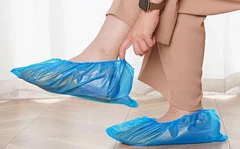






In theory, disposable shoe covers are among the simplest items in the PPE category. They are inexpensive, easy to use, and widely available.
Yet in practice, many buyers only realize there is a problem after the product has already been put into use - when covers start tearing too quickly, slipping off, or failing to provide the expected level of protection.
These issues are rarely caused by a single factor. More often, they come from small decisions made during the purchasing process.
When "They All Look the Same" Becomes a Problem
At a glance, most CPE shoe covers look nearly identical. Thin plastic, elastic opening, standard blue or white color - it's easy to assume they perform the same.
But once used in real environments, differences begin to show.
In wet areas such as hospital cleaning zones or food processing floors, lower-grade products may stretch unevenly or split at the seam after only a short period of walking. This is often linked to variations in film quality and sealing temperature during production - details that are not visible in product photos or basic specifications.
For buyers, relying only on appearance or price comparison can lead to inconsistent performance across batches.
Material Description vs. Actual Performance
Many suppliers describe their products simply as "CPE shoe covers," but this alone does not guarantee durability.
The behavior of CPE material depends heavily on:
- Film thickness consistency
- Raw material blending
- Cooling and forming conditions during production
Even within a similar thickness range (for example, around 30–40 microns), the feel and strength of the material can vary significantly.
In some cases, buyers receive samples that perform well, but bulk orders show noticeable differences. This usually reflects inconsistency in raw material sourcing or process control - something that is difficult to detect without repeated orders.
The Overlooked Weak Point: Elastic and Sealing
One of the most common complaints from end users is not about the material itself, but about how the shoe cover fits.
Elastic bands that are too loose will cause the cover to slip off during walking. Bands that are too tight may create stress points where the material tears, especially when worn over safety shoes.
The connection between the elastic and the film is another critical detail. If the bonding is uneven, the opening may fail before the material itself shows any damage.
These are small manufacturing details, but they often determine whether a product works reliably in daily use.
Cost Decisions That Increase Usage Instead of Reducing It
Low unit price is often a key factor in purchasing decisions. However, with disposable products, the actual cost is not only determined by price per piece.
If a shoe cover needs to be replaced multiple times during a single shift due to tearing or poor fit, total consumption increases. In high-traffic environments, this difference becomes noticeable very quickly.
In practice, a slightly more stable product can reduce overall usage, even if the initial price is higher.
Different Environments, Different Expectations
Not all workplaces require the same level of performance from disposable shoe covers.
- In dry environments, lightweight options may be sufficient
- In wet or frequently cleaned areas, stronger waterproof performance becomes essential
- In high-movement workplaces, durability and fit matter more than thickness alone
Problems often arise when a single product is used across all scenarios without adjustment.
Understanding where and how the product will be used is just as important as the product itself.
A More Practical Way to Evaluate CPE Shoe Covers
Instead of focusing only on specifications, many buyers gradually shift toward evaluating products based on real usage:
- How long does one pair last during a typical shift?
- Does it remain stable when walking on wet floors?
- Are there noticeable differences between batches?
These questions are rarely listed in product descriptions, but they reflect actual performance.
Manufacturers with longer experience in disposable protective products, such as CARESTAR, tend to focus more on consistency across production runs rather than only meeting minimum specifications. This becomes particularly important for distributors and bulk buyers.