












Can Cheap CPE Shoe Covers Actually Increase Your Costs?
At first glance, disposable shoe covers seem like one of the easiest items to purchase.
They are low-value, widely available, and usually sold in large quantities. For many buyers, the decision often comes down to a simple comparison - price per piece.
When Lower Price Starts Showing Up on the Floor,the difference usually becomes visible after the product is put into use.
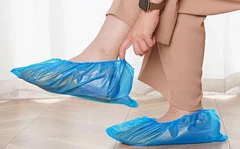
In a hospital cleaning area or a food processing workshop, workers are constantly moving. Floors may be wet, slightly rough, or exposed to cleaning chemicals. Under these conditions, some CPE shoe covers hold their shape and last through a full shift, while others begin to stretch out, tear, or slip off much earlier.
The issue isn't always dramatic. It's often small things:
- A cover splits when stepping over a drain.
- Another one loosens after a few minutes of walking.
- Someone stops to adjust it, then replaces it entirely.
Individually, these moments don't seem significant. Over time, they add up.
Usage Rate vs. Unit Price
What many buyers eventually notice is that the real cost is not tied to the unit price alone, but to how quickly the product is consumed.
For example, if a lower-cost shoe cover needs to be replaced two or three times during a shift, the total usage can easily exceed that of a slightly more durable option.
This becomes especially clear in high-volume environments:
- Facilities where hundreds of workers change footwear protection daily
- Areas that require frequent entry and exit between zones
- Workplaces with continuous movement rather than static positions
In these situations, a small difference in durability translates directly into higher consumption.
The Less Visible Cost: Workflow Interruptions
There is also a cost that rarely appears in spreadsheets.
When a shoe cover fails, work pauses - even if only for a few seconds. Workers stop to replace it, supervisors may need to restock supplies, and in some environments, re-entry procedures must be repeated.
In controlled areas such as food production or clean zones, even a brief interruption can slow down the process more than expected.
These are not large disruptions, but they happen frequently enough to affect efficiency over time.
Looking at Cost from a Different Angle
In practice, experienced buyers tend to evaluate disposable products differently over time.
Instead of asking "Which one is cheaper per piece?", the question gradually becomes:
- How long does one cover last during actual use?
- How often do workers need to replace it?
- Does performance stay consistent across batches?
These are not always easy to measure, but they reflect the real cost much more accurately.
A Shift Toward Stability Rather Than Minimum Price
As demand for disposable protective products grows, especially in hygiene-sensitive industries, more buyers are prioritizing consistency over short-term savings.
Manufacturers with more stable production processes - for example, those focusing on controlled film thickness and reliable sealing - tend to deliver products that behave predictably in daily use.
Companies like CARESTAR, which have long-term experience in disposable protective products, often emphasize this type of consistency rather than competing only on price.