






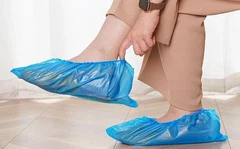






Choose disposable shoe covers for hospitals by the zone, not by the cheapest box. Dry corridors, outpatient waiting areas and general wards usually take lightweight PP nonwoven covers. Wet floors, spill-prone labs, isolation anterooms and dialysis rooms take continuous CPE film covers that block tracked moisture. Rough service corridors and outdoor-to-indoor transitions take heavy-duty CPE. On polished or wet tile, use the embossed non-skid version, because a smooth CPE sole is a slip risk.
WHAT HOSPITAL PROCUREMENT ACTUALLY BUYS ?
A hospital shoe cover program is not one SKU. It is a small matrix matched to the flow of people and the risk of each zone. Procurement teams that buy a single cover for the whole campus end up with either a cover that tears on the loading dock or a cover that costs too much for a dry corridor.
The buying questions are simple. Where does the cover go on? Who wears it, staff or visitors? Is the floor dry, damp or polished? Is the cover changed between rooms or just at the entrance? How many pairs does a ward go through in a shift? Once those answers are on paper, the material choice falls out.
PP NONWOVEN, CPE FILM AND LAMINATED: WHAT EACH ONE DOES
PP spunbond nonwoven. This is the light, breathable fabric cover. It sheds dust and hair from street shoes and it is comfortable for long visits, but it is not waterproof. On a wet floor, rain boots or spilled fluid, PP lets moisture through and can tear on rough thresholds. It belongs in dry, low-risk entry zones.
CPE film. This is the continuous plastic cover. It blocks ordinary tracked moisture and light splashes, sheds very little lint, and is the standard choice for clinical entry control, labs and isolation anterooms. It is less breathable than PP, so it is not the cover for a long walk through a public lobby, but it is the right layer where moisture and splash matter.
WATERPROOF IS NOT A MARKETING WORD
When a supplier says "waterproof," ask for the hydrostatic head number. The common test methods are AATCC 127 and ISO 811, which measure how much water pressure a fabric or film takes before it leaks through. A PP nonwoven cover reads near zero on this test because water passes through the fibers. A continuous CPE film does not rely on a treated surface; the film itself is the barrier, so it handles light splashes and tracked-in water without absorbing them.
But hydrostatic head is not the whole story. A cover that survives a standing water test still tears on a sharp threshold, and a heavy cover that survives the threshold still slips on polished tile. Buyers should ask for the film weight in grams per pair, the seam style, and whether the sole is smooth or embossed, not just the word waterproof.
SLIP RESISTANCE ON HOSPITAL FLOORS
Hospital floors are polished vinyl, epoxy tile, and they get mopped often. A smooth CPE shoe cover is a plastic sole on a wet plastic floor, which is exactly the combination that causes slips. The relevant test methods are EN ISO 13287 for footwear slip resistance and ASTM F2913 as the North American floor-shoe test.
The practical rule: on dry, low-risk floors a smooth CPE cover is fine. On polished or regularly wet tile, specify the embossed non-skid CPE shoe cover, where the textured sole pattern breaks the suction between the cover and the floor. Do not assume a cover is non-slip because it is thick; smooth thick film is still smooth.
CLEANROOM AND OPERATING ROOM BOUNDARIES
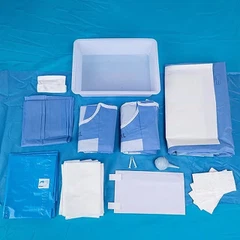
A disposable shoe cover on a street shoe is an entry-control layer, not a sterile garment. Cleanroom class is measured on airborne particles under ISO 14644-1, and the sterile core of an operating room runs a gowning protocol that includes dedicated scrub attire, hoods, masks and dedicated footwear or covers under local policy.
What this means for ordering:
A CPE shoe cover belongs in corridors, patient rooms, outpatient labs and visitor entry.
For sterile OR entry, follow the hospital gowning SOP and use the dedicated OR footwear cover.
For ISO 14644 cleanrooms in pharmaceutical or device manufacturing, specify a low-lint cover and confirm the particle data with the cleanroom qualification.
Do not let a supplier's "medical grade" label imply sterile performance. Ask what the claim actually covers.
HYGIENE, LATEX AND COMPLIANCE PAPERWORK
A hospital order needs paperwork, not just samples.
The factory quality system should be certified to ISO 9001:2015, and medical-device-related production to ISO 13485:2016.
The facility should be FDA registered for the US market, and EU buyers should confirm the importer's MDR filing.
The finished product should meet the local disposable hygiene microbial limits, for example GB 15979-2002 for the Chinese production standard.
The elastic should be latex-free spandex, because latex allergy remains a real procurement concern.
Each carton should carry a lot number and production date for traceability.
Ask for the certificates before the sample arrives, and confirm which certificates cover the specific SKU rather than the whole company.
PACK FORMAT UNIT: WHERE BUYERS GET BURNED
Shoe covers are sold by the pair, by the pack and by the carton, and suppliers use the word "piece" loosely. A "100 piece" pack can mean 100 individual covers, which is only 50 pairs, or it can mean 100 pairs. When comparing quotes, force the quote to state: pairs per retail pack, packs per carton, and pairs per carton. Build the price per pair and the price per ward-per-day, not the price per box.
Hospital shelves also care about pack format. A 100-pair retail pack with a header hole fits a nurse-station shelf or a peg display; a sealed master carton belongs in central stores, not on the ward.
HOW TO BUILD THE HOSPITAL SPEC
A reusable spec line prevents drift between orders:
Zone and floor type: dry corridor, wet clinical, polished tile, rough service.
Material: PP nonwoven, standard CPE film, embossed non-skid CPE, or heavy-duty CPE.
Weight: grams per pair, measured consistently.
Sole: smooth versus embossed.
Elastic: latex-free spandex.
Pack: pairs per retail pack, packs per carton, lot number and date printed.
Paperwork: ISO 9001, ISO 13485, FDA registration, hygiene report, and the importer's local filing.
Sample step: walk the sample on the actual hospital floor over the actual staff shoe before bulk approval.
FAQ
Q: What is the best shoe cover for hospital corridors? A: For dry corridors, a lightweight PP nonwoven cover is usually enough. For wet or fluid-prone clinical areas, use a continuous CPE film cover.
Q: Are CPE shoe covers waterproof? A: They block ordinary tracked moisture and light splashes as a continuous film. For true standing-water exposure, ask for hydrostatic head data under AATCC 127 or ISO 811 rather than the word waterproof.
Q: Are CPE shoe covers safe on polished hospital floors? A: A smooth CPE sole can be slippery on wet polished tile. Use the embossed non-skid version for those floors.
Q: Can these shoe covers be used in the operating room? A: They are entry-control covers for corridors and patient areas, not a sterile OR layer. Follow the hospital gowning SOP for the sterile core.
Q: Are the elastic bands latex-free? A: Standard CARESTAR CPE shoe covers use spandex elastic and are natural-rubber-free.
Q: How many pairs should a hospital stock per pack? A: A 100-pair retail pack is the common ward restock unit. Confirm pairs versus pieces, packs per carton and price per pair before ordering.
Q: What certifications should a supplier show? A: ISO 9001:2015 and ISO 13485:2016 quality system, FDA registration for the US, the local hygiene report, and the importer's MDR filing for the EU.