






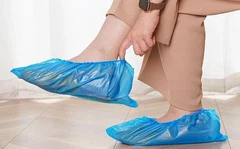






Ordering disposable shoe covers in bulk is not simply a matter of estimating how many people enter a facility each day. Purchasing teams also need to consider how often each person changes footwear protection, how the covers are distributed, how many pieces are packed in each bag, and how much reserve stock is needed.
An inaccurate estimate can create two problems. Under-ordering may interrupt daily operations, while excessive purchasing ties up warehouse space and working capital.
For facilities using CPE shoe covers, a practical purchasing calculation should begin with actual footwear-cover consumption rather than a rough estimate based on employee or visitor numbers.
1. Start with the Actual Number of Shoe Cover Uses
The first step is to identify how many people need shoe covers and how frequently they enter the controlled area.
A visitor who enters a facility once per day has a different consumption pattern from a maintenance technician who moves between several controlled zones.
Before calculating an order, collect four basic figures:
- Average number of people entering the area per day
- Average number of entries per person per day
- Number of operating days covered by the order
- Number of shoe covers used during each entry
One important distinction is that a pair of shoe covers normally means two individual pieces: one for each shoe. If the supplier quotes packaging in pieces rather than pairs, the purchasing calculation must use the same unit.
2. Use a Simple Bulk Purchasing Formula
For a facility where one person uses one pair of shoe covers per entry, the basic formula is:
Required Quantity (pieces) = Daily Users × Entries per User × Operating Days × 2
The multiplication by two accounts for the left and right shoes.
If the facility uses a different distribution procedure, replace the figure of two with the actual number of pieces consumed per entry.
For example, a food processing facility has the following estimated monthly demand:
|
Planning Factor |
Example |
|---|---|
|
Daily users |
180 people |
|
Entries per user per day |
1 |
|
Shoe covers per entry |
2 pieces |
|
Operating days |
22 days |
|
Estimated monthly consumption |
7,920 pieces |
3. Add an Inventory Buffer Based on Operational Risk
A bulk order should normally include a reasonable reserve for unexpected consumption.
Demand may increase because of:
- Temporary workers or additional visitors
- Production schedule changes
- Higher-than-expected footwear-cover replacement
- Damaged packaging or unusable pieces
- Delays between purchase orders and replenishment
A facility can calculate its reserve using a percentage selected from its own consumption history and replenishment lead time.
Round this figure up to a practical whole-piece quantity before matching it to the supplier's packaging configuration.
An 8% buffer is only an example. It is not an industry standard or a universal recommendation. Facilities with stable consumption and short replenishment times may need less reserve, while sites with irregular demand or longer procurement cycles may require more.
4. Convert the Quantity into Bags and Cartons
The calculated number of pieces is not necessarily the quantity that can be ordered directly.
Purchasing teams should confirm whether the supplier quotes:
- Individual pieces
- Pairs
- Bundles
- Bags
- Cartons
These units are not interchangeable.
For example, the currently published CS401O product page lists the following packaging configuration:
- 10 pieces per bundle
- 100 pieces per polybag
- 1,000 pieces per carton
These figures should be confirmed with the supplier before issuing a purchase order, especially when customized packaging is requested.
Carestar Medical
Using this published configuration, the example requirement of 8,554 pieces would be rounded up to nine cartons:
9 cartons × 1,000 pieces = 9,000 pieces
This leaves approximately 446 pieces above the calculated requirement.
The final order quantity should be based on the confirmed packaging configuration, actual consumption and storage capacity.
5. Check Whether the Product Specification Matches the Facility
Quantity planning is only one part of bulk procurement. The selected product must also match the facility's operating conditions.
A purchasing specification should include the following information:
|
Specification |
What to Confirm |
|---|---|
|
Material |
CPE or another specified material |
|
Product construction |
Handmade or machine-made |
|
Individual weight |
Confirmed weight per piece |
|
Dimensions |
Length and width |
|
Opening design |
Elastic opening and fit |
|
Surface |
Smooth or textured, if applicable |
|
Color |
Available standard or customized colors |
|
Packaging |
Pieces per bundle, bag and carton |
|
Customization |
Available size, weight, color or packaging options |
Do not compare products using material names alone. Two CPE shoe covers may have different weights, dimensions, construction methods and packaging configurations.
For larger orders, request a representative sample and verify the dimensions, weight and fit before confirming the production specification.
6. Why Weight and Dimensions Matter in Bulk Orders
The weight of a disposable shoe cover affects the amount of material used per piece and can influence the overall purchasing cost.
However, weight should not be treated as the only measure of product quality.
A meaningful comparison should consider:
Individual weight and its permitted production tolerance
Film thickness, if specified and measured
Product dimensions
Elastic attachment and opening consistency
Surface condition and visible defects
Fit on the footwear commonly used at the facility
For example, a buyer comparing two products should avoid assuming that the heavier option is automatically more suitable. The correct choice depends on the required dimensions, intended use, material construction and the facility's actual handling conditions.
For repeat orders, retaining an approved sample and written specification provides a useful reference for checking consistency between batches.
7. Build a Replenishment Plan Instead of Ordering Only Once
A bulk order should cover a defined purchasing period.
For regular operations, procurement teams can use historical consumption to estimate the next replenishment date.
A simple approach is:
Average Daily Consumption = Total Pieces Used ÷ Operating Days
Then:
Estimated Stock Coverage (days) = Available Usable Stock ÷ Average Daily Consumption
For example, if a facility uses 360 pieces per operating day and has 7,200 usable pieces in stock:
7,200 ÷ 360 = 20 operating days of stock
This calculation helps purchasing teams identify when to prepare the next order.
The replenishment point should also consider supplier production lead time, transportation time, receiving inspection and internal approval procedures.
8. What Information Should Be Included in a Bulk RFQ?
A clear request for quotation helps suppliers provide comparable offers.
Instead of asking only for a price per carton, include the product and order requirements.
A practical RFQ should contain:
Material: CPE
Product type: disposable shoe cover
Construction: handmade or machine-made, as required
Required dimensions
Target individual weight
Color requirements
Packaging quantity per bag and carton
Estimated order quantity
Delivery destination and requested delivery schedule
Sample and customization requirements
If the product is intended for a controlled environment, also describe the actual site requirements. Do not assume that a general-purpose disposable shoe cover automatically meets a particular cleanroom, pharmaceutical or medical standard.
Suppliers should confirm which specifications they can manufacture and provide supporting product information where required.
Accurate CPE shoe cover purchasing starts with actual consumption data. By calculating usage per entry, adding a justified inventory buffer and converting the result into confirmed packaging units, procurement teams can prepare more reliable bulk orders.
The most useful purchasing specification is one that connects quantity, dimensions, weight, construction and packaging in a single document. This makes supplier comparison easier and provides a consistent reference for repeat orders.
Need CPE shoe covers for a bulk purchasing project? Share your expected quantity, preferred dimensions, weight and packaging requirements with the supplier so that the product configuration can be confirmed before ordering.