












How Are CPE Shoe Covers Manufactured?
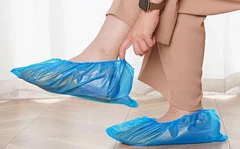
From the outside, a disposable shoe cover looks like a very simple product - a thin plastic layer with an elastic opening. But if you trace it back through the production process, there is more happening than most buyers expect.
For companies sourcing CPE shoe covers in bulk, understanding how they are made can actually explain a lot about product quality: why some tear easily, why some feel thicker, or why sizing and elasticity can vary from supplier to supplier.
It Starts with CPE Film - Not All Film Is the Same
The process usually begins with CPE film production. CPE (chlorinated polyethylene) is not used in the same way as standard PE film. The material is modified to improve flexibility and resistance to tearing, which is why it behaves differently during both manufacturing and use.
In most factories, the film is produced through a blown film extrusion process. Melted raw material is pushed through a circular die, forming a thin tube that is then inflated and cooled. This creates a continuous film roll.
At this stage, small variations already begin to matter:
- Film thickness may range roughly from 30 to 50 microns, depending on the intended use
- Cooling speed affects how flexible or "stiff" the film feels
- Material blending determines how well the film resists tearing under tension
If the film quality is inconsistent here, it will show up later as weak points in the finished shoe cover.
Embossing: A Small Step That Changes Performance
Before the film is cut and shaped, many manufacturers run it through an embossing process. This is where the slightly textured pattern on the surface is created.
The embossing is done using heated rollers with engraved patterns. As the film passes through, pressure transfers the pattern onto the surface.
This step is often underestimated, but it has two practical effects:
It increases surface friction, helping reduce slipping on wet floors
It slightly improves the mechanical strength of the film by redistributing stress
Different factories use different embossing patterns - some are shallow and barely visible, others are more pronounced. The depth and consistency of this pattern can affect how the shoe cover performs in real environments like food processing plants or hospital corridors.
Cutting and Shaping the Shoe Cover
Once the film is ready, it is fed into an automated machine that handles cutting and forming.
Instead of producing each shoe cover individually, machines typically work in a continuous process:
- The film is folded into layers
- Heat sealing lines define the shape of each cover
- The outline is cut while sealing the edges at the same time
This combination of cutting and sealing is critical. If the temperature is too low, the seam may open during use. If it is too high, the material can become brittle along the edges.
In practice, experienced operators adjust sealing temperature depending on:
- Film thickness
- Production speed
- Ambient factory conditions
These are small adjustments, but they directly influence durability.
Elastic Band Attachment - A Common Weak Point
After the basic shape is formed, the next step is adding the elastic band.
This is usually done using a heat-bonding process, where the elastic is stretched and attached around the opening of the shoe cover. When released, it contracts to create a snug fit.
This step is where many lower-quality products fail.
If the bonding is uneven:
The elastic may detach after minimal use
The opening may lose tension and slip off
Stress concentration can cause tearing near the seam
Some manufacturers reinforce this area by slightly widening the sealing zone or adjusting the tension of the elastic during bonding.
In large-scale production, consistency here is more important than speed.
Why Manufacturing Details Matter for Buyers?
For most end users, a shoe cover is disposable. But for importers, distributors, or facility managers, the manufacturing process directly affects:
- Product consistency across batches
- Complaint rates from customers
- Overall cost of use (not just unit price)
A slightly thicker film, a better sealing line, or a more stable elastic band can reduce breakage and replacement frequency - which becomes noticeable at scale.
Manufacturers with longer experience in disposable protective products, such as CARESTAR, tend to focus more on process stability rather than just output volume. This is particularly important for clients ordering large quantities where consistency matters more than minor cost differences.