











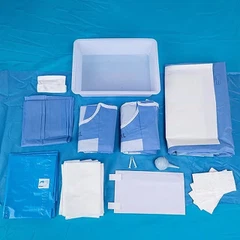



Surgical gowns are reinforced in the zones that take the most stress and the most fluid - the sleeves, the chest, and the front panel - because those are the areas where a surgeon reaches, bends, and encounters splash during a procedure. Reinforcement adds extra material (often another SMS layer) so the gown resists tearing and fluid penetration exactly where the barrier is under the most strain. Without it, a gown can fail at the wrist or chest at the worst moment. Here's how reinforcement works, where it belongs, and how it maps to the AAMI PB70 levels.
WHY REINFORCEMENT MATTERS IN SURGERY ?
A surgical gown is a single-use barrier, but not every part of it is under the same stress. A surgeon reaches into a field, pulls, twists, and leans forward for minutes at a time. Blood and fluid splash toward the arms and chest. The gown's job is to stay intact through all of it - and that is where reinforcement earns its place.
A gown that is uniform thickness everywhere has to be either thick enough for the hardest zone (which makes the whole gown heavy and hot) or thin enough to be comfortable (which risks failure where the stress is highest). Reinforcement solves that by putting extra material only where the gown actually needs it.
If reinforcement fails, the consequences are serious. A tear at the sleeve or a penetration at the chest breaks the barrier, and the surgical team loses the protection the gown was supposed to provide. Reinforcement is the engineering answer to that risk.
THE THREE REINFORCED ZONES
Sleeves - the highest-stress area. The arms do the most reaching, pulling, and movement in surgery. The sleeves are also where the gown meets the glove, and where fluid runs down the arm during a procedure. This is why sleeve reinforcement is the most important zone, and why elastic or knit cuffs - or thumb loops - are used to seal the sleeve under the glove.
Chest - the splash target. When a surgeon leans over a field, the chest is the closest surface to the work and the most likely to take a fluid splash. The chest panel is reinforced to resist penetration right where the exposure is concentrated.
Front panel - the work zone. The lower front of the gown faces the patient and the procedure. It takes contact, friction, and splash, so the front panel is reinforced to resist both penetration and mechanical stress.
Some gowns also reinforce the area around the opening or add a fluid-resistant layer across the full front. The principle is the same: put the extra barrier where the work happens.
HOW REINFORCEMENT IS BUILT ?
Reinforcement is usually extra SMS (spunbond-meltblown-spunbond) material bonded into the critical zones, or an additional layer of SMS laminated over the base fabric. SMS already layers a spunbond outer, a meltblown filter middle, and a spunbond inner; reinforcement adds another SMS ply on top in the reinforced zones.
The result is a gown that is lighter in the low-stress back and heavier in the high-stress sleeves and chest - protection where it matters without turning the whole gown into a heat trap. That balance is what makes a reinforced surgical gown wearable for a full procedure.
REINFORCEMENT AND THE AAMI PB70 LEVELS
The AAMI PB70 standard sorts gowns into four liquid-barrier levels. Reinforcement and barrier level work together, but they are not the same thing: the level is a tested performance grade, while reinforcement is a construction choice that helps a gown meet and hold that grade.
Level : Barrier Test (synthetic blood) Typical Use Level 1 : Minimal resistance Basic care, minimal fluid Level 2 : Low resistance Routine care, light fluid Level 3 : Moderate resistance Surgery, moderate fluid splash Level 4 : High resistance High-fluid procedures
A Level 3 gown must pass ASTM F1670, the synthetic blood penetration test. That is the test that separates a surgical gown from an isolation gown. Reinforcement supports the Level 3 rating by keeping the barrier intact under stress. For higher-risk claims, some Level 3 and all Level 4 gowns are tested to ASTM F1671, the viral penetration test, which is a tougher challenge.
What this means for a buyer: if you need Level 3, look for ASTM F1670 on the certificate, and check that the sleeves and chest are reinforced - because a gown that tests well on paper but tears at the wrist in use has failed its job.
REINFORCEMENT vs ISOLATION GOWNS
It helps to know what a reinforced surgical gown is not. An isolation gown - typically AAMI Level 1 or Level 2 - is lighter, less fluid-resistant, and not reinforced for surgery. It is for routine care, contact isolation, and low-fluid tasks. It is not rated for the moderate fluid splash of a surgical procedure.
WHAT A BUYER SHOULD ACTUALLY DO ?
Confirm the AAMI level. Ask for the AAMI PB70 test report and the ASTM F1670 certificate for a Level 3 gown. If it's not on paper, it's not a Level 3.
Check the reinforced zones. Verify the sleeves and chest are reinforced - that is where a gown fails in use.
Ask about ASTM F1671. If your procedures involve higher-risk fluid exposure, ask whether the gown is also tested for viral penetration.
Confirm breathability. A reinforced gown still needs SMS comfort for procedure-length wear, or staff will take it off.
Ask about traceability. A batch-traceable gown from an ISO 13485 facility gives you documentation for tenders and distributors.
BUILD A COMPLETE PROCEDURE-ROOM KIT
At CARESTAR we make reinforced surgical gowns to AAMI Level 3, plus Level 2 isolation gowns and economical CPE gowns, so you can cover the full range from one certified factory. Pair a Level 3 surgical gown (https://www.carestarmedical.com/surgical-gown/surgical-gown-aami-pb70-level-3/) with a matching surgical face mask Type IIR (https://www.carestarmedical.com/face-mask/astm-l1-2-3-face-mask/) and disposable bouffant cap for a complete, documented procedure-room kit.