











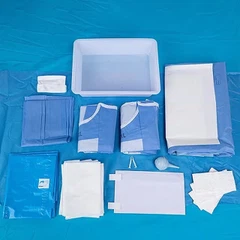


When evaluating a surgical gown, the fabric usually receives most of the attention. Buyers often compare material type, weight, softness, breathability, and fluid resistance before looking at how the garment is assembled.
Yet the fabric is only one part of the protective system.
A surgical gown can use a material with good barrier properties and still have vulnerable areas if the seams are not appropriately constructed. Every point where two pieces of material are joined creates a potential pathway that needs to be considered.
This is why surgical gown seam construction can have a direct relationship with overall barrier performance.
For hospitals, medical distributors, and PPE procurement teams, understanding this relationship makes it easier to evaluate surgical gowns based on their actual construction rather than relying only on fabric specifications.
Why are seams important in a surgical gown?
A surgical gown is normally manufactured from several cut pieces rather than one continuous sheet of material.
These pieces need to be joined around areas such as:
- Shoulders
- Sleeves
- Side panels
- Cuffs
- Neck openings
- Front and back sections
The joining method creates a seam.
From a mechanical perspective, the seam needs to keep the garment together while the wearer moves. From a barrier perspective, it also needs to avoid creating a weak point where fluids could potentially pass through.
This creates two related requirements:
Mechanical integrity + barrier integrity
A seam that is strong enough to prevent tearing is not automatically a seam with the desired fluid-barrier performance.
Likewise, a seam with good barrier characteristics still needs sufficient mechanical strength for the intended application.
Not all seams provide the same level of protection
The way two pieces of gown material are joined can vary considerably.
Common construction approaches include:
- Sewn seams
- Ultrasonic-welded seams
- Heat-sealed seams
- Taped seams
- Other bonded constructions
The appropriate method depends on the material, gown design, intended protection level, manufacturing process, and applicable performance requirements.
For this reason, simply asking whether a surgical gown has "sealed seams" does not provide enough information.
Buyers should also consider where the seams are located, how they are constructed, and what level of barrier performance has actually been demonstrated through testing.
Sewn seams: practical and widely used
Sewn seams are familiar throughout garment manufacturing and can provide reliable mechanical joining when properly designed and manufactured.
They are particularly useful when flexibility and garment construction are important considerations.
However, stitching introduces needle penetration through the material.
This means the seam construction needs to be evaluated differently from the surrounding fabric.
For applications where fluid penetration resistance is important, the seam may require additional treatment or another construction method depending on the required level of protection.
A sewn seam should therefore not automatically be considered equivalent to the unseamed portion of the fabric.
Ultrasonic and heat-sealed seams
Ultrasonic welding and heat sealing use controlled energy or heat to bond suitable materials together.
Instead of relying solely on thread, the materials themselves can be joined to create a continuous bonded area.
These techniques can be useful for disposable protective garments because they can reduce some of the potential pathways associated with conventional stitching.
However, performance depends heavily on process control.
Factors such as:
- Temperature
- Pressure
- Energy input
- Material composition
- Bond width
- Equipment calibration
can influence the resulting seam.
A sealed seam is therefore not automatically a high-performance seam. Manufacturing consistency matters.
Taped seams add another barrier layer
In some protective garments, seam tape is applied over a sewn or bonded seam.
The purpose is to cover the seam area and reduce potential pathways for liquid penetration.
This approach can be useful when a garment requires enhanced barrier protection, particularly in applications where fluid exposure is an important consideration.
The tape itself, however, becomes part of the overall system.
Its adhesion, coverage, flexibility, and compatibility with the underlying material all matter.
If the tape does not bond consistently, the seam may not perform as intended.
Why seam location matters?
Not every seam on a surgical gown is exposed to the same conditions.
A shoulder seam, for example, may experience significant mechanical movement as the wearer raises or rotates an arm.
A side seam may experience different stresses when the wearer bends or turns.
Sleeve seams can be exposed to repeated movement and contact with gloves or other equipment.
Therefore, seam performance should be evaluated in relation to its position on the garment.
A useful product assessment considers:
- Seam type + seam location + expected movement + exposure level
- rather than evaluating the seam as an isolated feature.
- Movement can place additional stress on seams
A surgical procedure can involve hundreds of repetitive movements.
The wearer may:
- Reach across a procedure area
- Raise the arms
- Bend forward
- Turn the upper body
- Move equipment
- Handle instruments
- Adjust positioning
Every movement can create tension in different sections of the gown.
If the garment pattern is poorly matched to the material, excessive stress may concentrate around certain seams.
This is why gown design and seam construction should be considered together.
A strong material cannot fully compensate for an unsuitable pattern, while a carefully designed pattern cannot eliminate the need for appropriate seam construction.
Fluid exposure changes the requirements
The importance of seam construction becomes more obvious when fluid exposure increases.
In a low-fluid environment, the main concern may be maintaining garment integrity and comfortable movement.
In a procedure involving blood or other potentially hazardous fluids, the barrier requirements become more demanding.
Fluid may encounter the gown in several ways:
- Direct contact with the fabric.
- Contact with a seam.
- Accumulation around a garment fold.
- Pressure against the material during movement.
- Extended exposure over time.
This means the seam cannot be evaluated separately from the overall fluid-barrier system.
The fabric, seams, closures, cuffs, and other garment components should be appropriate for the intended exposure.
Why hydrostatic pressure can matter ?
Fluid resistance is not simply a question of whether water appears to remain on the surface.
Under pressure, liquid can behave differently.
For example, when fluid accumulates against a garment surface or comes into contact with the material during movement, pressure can increase the challenge placed on the barrier.
This is one reason standardized barrier-performance testing is important.
A manufacturer may describe a gown as "fluid resistant," but procurement teams should look for the relevant test method, performance level, and intended application rather than relying on marketing terminology alone.
Seam performance should be supported by testing
Visual inspection can identify obvious manufacturing problems, but it cannot establish complete barrier performance.
For professional procurement, relevant testing may evaluate characteristics such as:
- Resistance to liquid penetration
- Seam integrity
- Material strength
- Tear resistance
- Puncture resistance
- Hydrostatic pressure performance
The exact tests required depend on the market, product classification, intended application, and applicable standards.
This is particularly important when gowns are being purchased for clinical environments with defined protection requirements.
A useful technical specification should therefore identify what has been tested, according to which method, and for which product configuration.
A simple way to compare surgical gown construction
When reviewing samples from different suppliers, procurement teams can create a basic construction checklist.
| Construction area | What to inspect | Why it matters |
|---|
| Shoulder seams | Joining consistency | Handles repeated arm movement |
| Sleeve seams | Stitching or bonding quality | Important during continuous movement |
| Side seams | Construction and strength | Contributes to overall garment integrity |
| Cuffs | Attachment and elasticity | Helps maintain sleeve position |
| Neck area | Closure and seam quality | Important for coverage and comfort |
| Front panel | Material and seam arrangement | May receive direct fluid exposure |
| Bonded areas | Uniformity | Helps maintain consistent barrier performance |
| Seam tape | Adhesion and coverage | Can reduce potential fluid pathways |
This kind of inspection is more useful than simply comparing photographs of two gowns.
What can happen when seam quality is inconsistent?
Manufacturing consistency becomes particularly important when purchasing disposable surgical gowns in large volumes.
A sample may appear satisfactory while inconsistent production creates differences between batches.
Potential issues can include:
- Uneven seam widths
- Loose stitching
- Incomplete bonding
- Poor tape adhesion
- Material damage around seams
- Inconsistent cuff attachment
- Weak points at seam intersections
These issues do not necessarily occur in every product or production batch, but they demonstrate why quality-control procedures matter.
For distributors and healthcare buyers, supplier evaluation should therefore include not only product specifications but also manufacturing consistency and quality-control practices.
Seam design is also related to wearer comfort
Barrier performance is important, but a surgical gown also needs to remain practical for the person wearing it.
Some reinforced or sealed constructions can add stiffness to particular areas of the garment.
If the seam becomes excessively rigid, it may restrict movement or create discomfort during longer procedures.
Manufacturers therefore need to balance:
- Barrier performance
- Mechanical strength
- Flexibility
- Breathability
- Garment weight
- Wearer comfort
The appropriate balance depends on the intended use.
A gown designed for a high-fluid-exposure procedure may have different construction priorities from one intended for routine surgical environments with lower fluid exposure.
How CARESTAR approaches surgical gown construction ?
CARESTAR supplies disposable surgical gowns for healthcare applications, with product configurations that can be adapted according to application requirements.
Depending on the intended use, buyers can discuss factors including:
- Material construction
- Sleeve and cuff configuration
- Seam construction
- Gown size
- Closure design
- Packaging
- Barrier-performance requirements
- Applicable testing requirements
For distributors and institutional buyers, this approach makes it possible to evaluate the gown as a complete protective garment rather than selecting a product based on fabric specifications alone.
When requesting samples, it is also useful to assess the finished gown during realistic movements and compare construction details across multiple samples.
The seams of a surgical gown may occupy only a small percentage of its total surface area, but they can play an important role in the garment's overall integrity.
A suitable seam needs to withstand the mechanical demands of the procedure while maintaining the level of barrier performance required for the intended application.
For this reason, surgical gown evaluation should look beyond fabric type and weight.
Seam construction, seam location, bonding quality, finished-garment testing, and manufacturing consistency all deserve attention.
For medical procurement teams, understanding these details can lead to a more meaningful comparison between suppliers and help ensure that the selected surgical gown matches the actual demands of the clinical environment.