











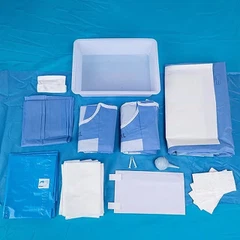


Two disposable surgical gowns can use similar nonwoven materials and have comparable overall coverage, yet feel quite different when worn. One may stay securely around the wrist while another may move during repeated arm movements. The difference can come down to the cuff and sleeve construction.
For surgical teams and medical procurement departments, these details are worth considering because a gown is used while staff are reaching, bending, handling instruments, and working around gloves and other protective equipment.
The sleeve is part of the protection system
The purpose of a surgical gown is not simply to cover the torso.
During a procedure, the arms and wrists can be involved in continuous movement. Sleeves may come into contact with gloves, instruments, equipment, or surrounding surfaces.
A well-designed sleeve needs to maintain coverage without unnecessarily restricting movement.
This creates a practical balance between several factors:
- Coverage
- Freedom of movement
- Sleeve stability
- Cuff fit
- Material strength
- Compatibility with surgical gloves
- Wearer comfort
The cuff therefore has a functional role rather than being merely a finishing detail.
Why are knitted cuffs commonly used?
Many disposable surgical gowns use knitted cuffs around the wrist.
A knitted cuff can provide a relatively close fit around the wrist while allowing the sleeve to remain in position as the wearer moves.
This is particularly useful when gloves are worn over the cuff.
Instead of leaving a loose sleeve opening around the wrist, the cuff creates a more controlled transition between the gown and glove.
The actual performance still depends on the cuff material, dimensions, elasticity, sewing quality, and overall gown construction. A "knitted cuff" label by itself does not guarantee the same performance from every product.
That is why buyers comparing surgical gowns should look at the complete construction rather than focusing on a single feature.
What happens when the cuff is too loose?
A loose cuff can create several practical problems.
During a procedure, repeated arm movement may cause the sleeve to shift toward the forearm. If the gown sleeve does not remain properly positioned beneath the glove, the transition between the gown and glove can become less controlled.
Loose sleeves can also interfere with tasks that require precise hand movement.
For surgical personnel, this can become particularly noticeable during longer procedures.
The problem is not necessarily that the gown material is poor. The issue may simply be that the sleeve and cuff were not designed for the way the garment is being used.
What if the cuff is too tight?
The opposite problem can occur when the cuff is excessively restrictive.
A surgical gown needs to remain secure, but it should also allow the wearer to work comfortably.
A cuff that creates excessive pressure around the wrist may become uncomfortable during extended use. It can also make the gown more difficult to put on or adjust.
For this reason, cuff design should balance retention and comfort.
This is one area where product evaluation by actual users can be more informative than relying solely on a specification sheet.
Different procedures may create different requirements
Not every healthcare environment needs exactly the same surgical gown construction.
For example, a procedure involving relatively limited fluid exposure may place greater emphasis on comfort and breathability.
A procedure involving greater fluid exposure may require more attention to barrier performance and the relevant protection classification.
Long procedures may increase the importance of:
- Breathability
- Moisture management
- Material flexibility
- Sleeve comfort
- Overall garment weight
In other words, surgical gown selection should begin with the actual working environment rather than with a generic product description.
How CARESTAR approaches disposable surgical gowns ?
For medical distributors, hospitals, and healthcare procurement teams, CARESTAR supplies disposable surgical gowns for professional healthcare applications.
Product configuration can be evaluated according to factors such as material construction, sleeve and cuff design, size, closure method, packaging, and intended application.
Rather than treating every surgical gown as an identical product, the purchasing specification should reflect the actual requirements of the healthcare environment.
The cuff on a surgical gown may be only a small part of the garment, but it plays an important role in how the sleeve behaves during use.
A good surgical gown needs more than adequate fabric coverage. Its sleeves, cuffs, seams, closures, and overall pattern need to work together.