






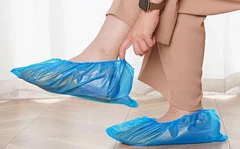






In various environments where hygiene, safety, and contamination control are paramount – such as hospitals, laboratories, cleanrooms, food processing facilities, and industrial workshops – shoe covers play a critical role in protecting floors, preventing cross-contamination, and ensuring personnel safety. While both CPE (Chlorinated Polyethylene) and PE (Polyethylene) are common materials used in shoe cover manufacturing, their distinct properties make them suitable for different applications. CPE, a chlorinated derivative of PE, offers enhanced durability, chemical resistance, and slip resistance, while PE excels in cost-effectiveness, transparency, and flexibility. Understanding these differences is essential for selecting the optimal shoe cover type that aligns with specific operational requirements and performance needs.
I. Advantages of CPE Shoe Covers:

- Superior Slip Resistance:
CPE shoe covers typically feature anti-slip particle designs on the surface, providing excellent grip and traction, making them ideal for slippery surfaces or environments requiring high slip resistance (such as laboratories, medical facilities, and cleanrooms).
- Enhanced Chemical Resistance & Anti-Aging:
CPE material, through chlorination treatment, offers superior resistance to acids, alkalis, oils, and heat-oxidation aging, making it suitable for environments involving chemical substances or higher temperatures.
- Higher Physical Strength:
Compared to PE, CPE shoe covers are more durable with better tear resistance and puncture resistance, resulting in longer service life, ideal for repeated use or high-intensity applications.
- Outstanding Flame Retardancy:
The chlorine content in CPE material provides self-extinguishing properties (no dripping when burned), offering superior flame retardancy compared to PE, suitable for fire-sensitive environments.
- Environmental Safety:
Non-toxic and free from heavy metals and PAHs, CPE complies with environmental standards and can be safely used in sensitive environments such as medical and food processing facilities.
- Customization Flexibility:
Supports customization of different thicknesses and hardness levels to meet specific protective requirements.
II. Advantages of PE Shoe Covers:


- Cost-Effectiveness:
PE material has lower costs and simpler production processes, making it economical for large-scale single-use applications, particularly in cost-sensitive scenarios.
- Softness & Comfort:
PE material is highly flexible and conforms well to foot contours, providing comfortable wear, suitable for short-term or light-duty protective needs (such as home or office environments).
- High Transparency:
PE shoe covers offer excellent transparency, allowing direct observation of shoe surface conditions, ideal for scenarios requiring visual inspection of shoe cleanliness.
- Environmental Recyclability:
PE material is recyclable, complying with environmental requirements, and waste disposal is more convenient (when properly sorted for plastic recycling).
- Processing Convenience:
Excellent processing properties enable rapid production of various specifications, meeting diverse size requirements (such as different shoe sizes).
- Reliable Basic Protection:
Provides effective barrier protection against dust, water, and contamination, suitable for basic protective scenarios in ordinary cleanrooms and dust-free workshops.
Summary & Application Recommendations:
CPE Shoe Covers: More suitable for high-slip resistance requirements, chemical corrosion resistance, repeated use, or long-term protective scenarios (such as medical surgeries, laboratory operations, industrial workshops).
PE Shoe Covers: More suitable for cost-sensitive, single-use, light-duty protection, or scenarios requiring high transparency (such as home cleaning, office dust prevention, food processing).
Selecting the appropriate material based on specific needs (such as usage frequency, environmental conditions, budget) will maximize protective effectiveness and cost-efficiency.