












How to Choose Between Type 5 and Type6 Disposable Coveralls ?
We receive inquiries every week from safety workers and distributors who are unsure whether they should order Type 5 or Type 6 disposable coveralls. It is a fair question because the two standards cover different hazards, and choosing the wrong one can leave a crew exposed.
Type 5 protection, tested under the European Norm standard EN ISO 13982-1, is designed for dry hazardous particles. If your staff are sanding composite materials, handling pharmaceutical powders, or working around insulation dust, the suit must block fine solids from reaching the skin. Type 6, which meets EN 13034, deals with something else entirely. It is for light liquid splashes, such as spray paint, machine oil, or agricultural chemicals. Most industrial sites do not face one hazard at a time. A maintenance team might spend the morning in a dusty environment and the afternoon pressure washing equipment. That is why we recommend a combined Type 5 and Type 6 certified garment for most of our customers. It is one suit that satisfies both requirements.
The certificate does not tell you how the suit will feel after eight hours in a hot workshop. Many imported coveralls use a heavy plastic film that does not allow air to pass through. Workers sweat, they get uncomfortable, and they end up unzipping the suit before the shift ends. At Carestar, we build our coveralls from a spunbond meltblown spunbond fabric or a breathable microporous film. This structure filters airborne particles while allowing body heat to escape. We have had customers in tropical regions tell us their staff finally stopped complaining about heat once they switched to this fabric weight.
We also pay attention to the parts of the suit that usually fail first. The zipper is an obvious weak point because it creates a line of holes straight down the chest. A coverall with just a sewn flap over the zip is not enough in a wet environment. We cover the zipper with a double storm flap, and we add an adhesive strip that the wearer presses down to create a liquid seal. Thumb loops are another feature we do not remove from the design. Without them, you lose the seal at the wrist every time a worker lifts an arm.
Fit is often treated as a comfort issue, but it is a safety issue. A suit that is too tight will tear across the seat when a person crouches. A suit that is too loose will catch on a pallet jack or a conveyor. We cut our patterns in sizes from Small to Five Extra Large, and we adjust the sleeve and torso length for different markets. The knees and the base of the zipper are reinforced because those are the points that take the most strain.
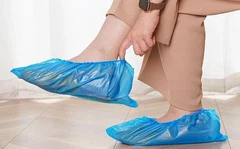
Footwear is part of the same system. We often remind buyers that a sealed coverall is useless if the worker tracks contaminants out of the area on their shoes. Because we manufacture our own disposable footwear protection, we can supply the right match. We make waterproof polyethylene overshoes with anti-skid dots for wet floors, and we make taller boot covers for agricultural or remediation work. Having one supplier for both the coverall and the shoe covers means the fabric quality and the delivery schedule stay consistent.
All Carestar coveralls are tested to the CE Category Three personal protective equipment requirements. Depending on the application, Carestar can add anti-static treatment that meets EN 1149-5, or protection against infective agents under EN 14126. We keep white and high-visibility blue in regular stock, and we offer custom manufacturing services for distributors who need their own logo and packaging.