






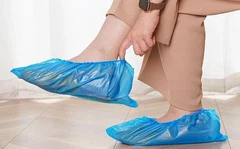






When purchasing disposable CPE shoe covers in bulk, buyers often compare price per piece before looking closely at the product specification. However, two shoe covers listed under the same material category may differ in weight, dimensions, surface design, and fit.
These differences matter in daily use. A cover that stretches too tightly around a work shoe may be difficult to put on, while an oversized cover may loosen during walking. A lightweight option may suit routine indoor use, but a more demanding application may require a different specification.
Understanding CPE shoe cover weight helps procurement teams compare products more accurately and avoid paying for a specification that does not match the actual job.
1. What Does Weight per Piece Tell You About a CPE Shoe Cover?
CPE stands for chlorinated polyethylene, a plastic material used in disposable footwear covers and other protective products.
For purchasing purposes, weight per piece is the mass of one shoe cover, usually expressed in grams. It is different from film thickness, which describes the thickness of the material itself.
Weight can provide a useful starting point when comparing products, but it should not be treated as a complete measure of quality.
Consider two CPE shoe covers with the same stated weight. If one is longer or wider, the material may be distributed across a larger area. Their fit, coverage, and resistance to tearing during use may therefore differ.
Material formulation, film processing, dimensions, and the design of the opening can also affect performance.
For this reason, buyers should compare weight together with dimensions and actual product samples rather than selecting a supplier on grams per piece alone.
2. How Does Weight Affect Fit and Durability?
Fit around the footwear
The opening and overall dimensions determine how easily a disposable shoe cover can be fitted over footwear.
A cover that is too small may require excessive stretching during application. This can place additional stress on the material, particularly around the elastic opening and other highly stretched areas.
A cover that is too large may provide unnecessary excess material and can be more difficult to keep in position.
When evaluating CPE shoe covers, procurement teams should test them on the actual footwear used at the facility. Standard shoes, wide safety shoes, and work boots can require different dimensions.
Resistance to tearing
Material weight can influence how much material is used in a product, but it does not independently determine tear resistance.
Two products of similar weight may behave differently because of differences in material quality, film thickness distribution, processing, and construction.
A practical comparison should examine whether the cover tears when being put on, whether the opening remains intact, and whether the material withstands normal walking and movement during the intended task.
Record these observations under consistent test conditions. This provides a more useful basis for supplier comparison than a general claim that a heavier cover is always stronger.
Comfort during use
Fit also affects how comfortable a disposable shoe cover feels.
If the cover is difficult to put on or restricts the footwear excessively, workers may spend more time changing it or may handle it incorrectly. Conversely, a cover with appropriate dimensions can be easier to apply and remove.
The objective is not simply to select the heaviest option. It is to identify a specification that provides adequate coverage and handling performance for the intended use.
3. Does a Heavier CPE Shoe Cover Always Offer Better Value?
Not necessarily.
A higher-weight product may use more material per piece, which can affect its purchase price. However, the relationship between weight and total cost depends on the supplier's pricing, product design, order quantity, and the way the covers are used.
A useful starting point is to calculate the material-weight requirement for a planned order.
For example, if a buyer orders 100,000 shoe covers:
- At 2.5 g per piece, the nominal product mass is 250 kg.
- At 3.0 g per piece, the nominal product mass is 300 kg.
- The difference is 50 kg across the order.
- These figures are illustrative calculations, not specifications or quotations for a CARESTAR product.
The example shows why even a small difference in grams per piece can matter in a large-volume purchase. It does not establish which option is cheaper, because actual prices may depend on material costs, production efficiency, packaging, freight, and other commercial factors.
Buyers should therefore compare both the quoted price per piece and the performance of the sample.
4. How Should Buyers Compare CPE Shoe Cover Specifications?
A structured comparison makes supplier quotations easier to evaluate.
Weight per piece
Ask the supplier to state the nominal weight and clarify the applicable production tolerance, if one is specified.
If weight is a key purchasing criterion, agree on a consistent method for checking samples or production batches.
Dimensions
Confirm the cover's length, width, opening size, and intended footwear range.
Do not assume that products described as one-size-fits-most will fit all shoes or work boots equally well.
Material and construction
Confirm that the offered product is made from CPE and identify any additional materials or construction features.
Where material composition is important to the purchasing specification, request the appropriate product documentation.
Surface design and traction
Some disposable shoe covers use textured surfaces intended to improve grip. However, the effectiveness of a surface depends on the floor, moisture, contaminants, footwear, and movement.
If traction is important, test the selected product under representative working conditions. A textured pattern alone is not proof of a particular slip-resistance level.
Packaging and order consistency
Confirm the number of pieces per bag, bags per carton, carton dimensions, and labeling requirements.
For repeat orders, retain an approved sample and a written specification. This helps buyers identify changes in weight, dimensions, or construction between deliveries.
5. How Can Buyers Select the Right Specification for Different Work Areas?
Different workplaces place different demands on disposable shoe covers.
Healthcare facilities: Consider the facility's footwear hygiene procedures, required coverage, fit, and disposal practices. Do not assume that a standard CPE shoe cover provides sterile protection or meets a particular medical performance requirement.
Food processing: Review the site's hygiene procedures and the conditions in which the covers will be worn. Where wet floors are present, evaluate footwear grip and workplace controls separately from the material weight.
Laboratories: Determine whether the cover is intended mainly to keep ordinary dirt off floors or whether the facility requires specific particle-control characteristics. Standard CPE film should not automatically be treated as a validated cleanroom solution.
Industrial maintenance: Check the dimensions against the shoes or boots worn by staff. Evaluate the cover's resistance to tearing during normal movements and confirm that it is appropriate for the specific task.
Selecting a product by application helps narrow the specification before requesting quotations.
6. What Should You Ask a CPE Shoe Cover Supplier Before Ordering?
Before placing a bulk order, ask the supplier to confirm the following:
- Is the product made from CPE, and what is the exact material specification?
- What are the nominal weight and dimensions per piece?
- What color and surface options are available?
- How does the cover fit the footwear used at your facility?
- What packaging configuration and order quantity can be supplied?
- Can samples be evaluated before mass production?
- What quality inspection records or product documents are available?
- Can the supplier maintain the approved specification across repeat orders?
These questions help turn a general product description into a purchasing specification that both parties can understand.
Choosing CPE Shoe Covers for Your Procurement Requirements
The most suitable CPE shoe cover is not necessarily the lightest or heaviest option. It is the product that meets the facility's requirements for fit, coverage, handling, and cost while remaining consistent across orders.
CARESTAR supplies disposable protective products, including CPE shoe covers in different product configurations. Buyers can review the available options and discuss their required dimensions, weight, color, and packaging before confirming an order.
For product details, visit the CARESTAR CPE Shoe Cover range.
If you are comparing several specifications for a bulk purchase, provide your footwear dimensions and intended working conditions so that the appropriate product options can be reviewed.