











Hey there! As a boot cover supplier, I often get asked a bunch of questions about our products. One question that pops up quite a bit is, "Can boot covers be used for wet boots?" Well, let's dig into this and find out the answer.
First off, let's talk about why someone might want to use boot covers on wet boots. There are a few scenarios. Maybe you're working in a job where you're constantly in wet conditions, like construction sites near water sources or agricultural fields after a heavy rain. You don't want to track that water and mud all over the place, so putting on a boot cover seems like a good idea. Or perhaps you're in a clean environment, like a laboratory or a food processing facility, and you need to prevent any contamination from your wet boots.
Now, there are different types of boot covers in the market, and each has its own properties when it comes to dealing with wet boots.
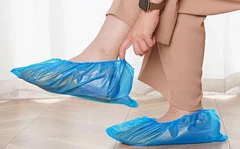
Let's start with the CPE Boot Cover. CPE, or chlorinated polyethylene, is a popular material for boot covers. It's known for its durability and water resistance. When it comes to wet boots, CPE boot covers can be a great option. They form a tight seal around the boot, preventing water from seeping out and onto the floor. The material is thick enough to withstand some rough handling, so even if you're walking through puddles or wet grass, the boot cover should stay intact. However, it's important to note that if the boots are extremely muddy or have sharp objects stuck to them, there's a small risk of the CPE getting punctured. But overall, for moderately wet boots, these boot covers work like a charm.
Another type is the Disposable CPE Coated PP Boot Cover. These are a bit different. The polypropylene (PP) base provides a lightweight and flexible structure, while the CPE coating adds that extra layer of water resistance. They're disposable, which is a huge plus if you're dealing with a lot of wet and dirty boots. You can just take them off and throw them away after use, saving you the hassle of cleaning. But because they're disposable, they might not be as durable as the regular CPE boot covers. If you're in a situation where you're constantly moving around and the boots are very wet, there's a chance the cover might tear. So, they're great for short - term use or in situations where you don't need a super - tough boot cover.
Then we have the Microporous Boot Cover. These are a bit more high - tech. The microporous material has tiny holes that allow air to pass through while still blocking liquids. This means that your feet can breathe even when you're wearing the boot covers on wet boots. They're great for long - term use, especially in jobs where you're on your feet for hours in wet conditions. The breathability helps prevent that sweaty and uncomfortable feeling that you get with some other types of boot covers. But the microporous material might not be as strong as CPE in terms of physical durability. So, if there's a lot of abrasion or sharp objects, you might need to be a bit careful.
However, there are some things to keep in mind when using boot covers on wet boots. First of all, proper fitting is crucial. If the boot cover is too big, water can easily get in around the edges. On the other hand, if it's too small, it might tear when you try to put it on the wet boot. Make sure to choose the right size according to your boot dimensions.
Secondly, the condition of the boots matters. If the boots have large chunks of mud or debris on them, it can make it difficult to put on the boot cover properly. It's a good idea to knock off as much of the mud as possible before putting on the cover. This not only helps with the fitting but also reduces the risk of puncturing the boot cover.
Also, the environment where you'll be using the boot covers is important. If it's a very cold environment, some materials might become brittle. For example, in sub - zero temperatures, the CPE boot covers might crack more easily. So, you need to consider the weather conditions as well.
In conclusion, boot covers can definitely be used for wet boots, but it depends on the type of boot cover, the condition of the boots, and the environment. If you need a durable option for long - term use in tough conditions, the CPE boot covers might be your best bet. For short - term and quick - fix situations, the disposable CPE coated PP boot covers are a great choice. And if breathability is your top priority, the microporous boot covers are worth considering.
If you're in the market for boot covers, whether it's for wet boots or other purposes, we're here to help. We've got a wide range of boot covers to suit different needs and budgets. Don't hesitate to reach out to us for more information, product samples, or to start a procurement discussion. We're always looking forward to working with new customers and providing the best boot cover solutions.
References:


- General knowledge from the boot cover industry
- Manufacturer specifications of different boot cover products